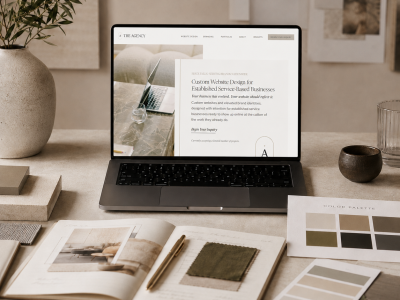
Why Your Website Is Getting Attention But Not Converting
There is a particular kind of frustration that happens when people are clearly interested in your business, but they are not taking the next step.
They are finding you. They are visiting your website. They may be coming from Instagram, Google, referrals, or word of mouth. They may be reading your services, looking through your work, clicking around, and spending time with your brand.
And then they leave.
No booking. No inquiry. No consultation request. No message.
It is easy to assume the problem is price. Or timing. Or the offer itself. And while those things can play a role, they are not always the real issue. More often, the problem is not that people are uninterested. It is that your website is not carrying them through the decision.
Interest Does Not Automatically Become Action
A visitor can be interested and still hesitate. They can admire your work and still not feel ready. They can need what you offer and still delay the decision. They can be the right kind of client and still close the tab instead of booking.
That is because the moment someone decides whether to inquire, schedule, or purchase is rarely just about information. It is about confidence.
Before someone takes the next step, they are quietly looking for reassurance. They want to feel that they understand your value, trust your process, know what to expect, and believe the experience will be worth their time, energy, and investment. Your website either strengthens that confidence or interrupts it.
And in a high-touch service business, even a subtle interruption can be enough to lose the conversion.
The Decision Point Is Where Most Websites Fall Short
Many websites are built to explain a business. Far fewer are built to move someone into action.
That distinction matters.
A website can be beautiful, informative, and technically functional while still failing at the most important moment: the point where an interested visitor decides whether to become a client.
This is where strategy matters. Your website has to do more than say what you offer. It has to create a feeling of certainty. It has to make the next step feel obvious, natural, and safe. It has to answer the questions your potential client may not even know how to ask yet.
When it does not, people rarely announce their hesitation. They simply leave.
They Are Interested, But They Do Not Fully Trust the Experience Yet
Trust is not built by saying you are trustworthy. It is built through consistency, clarity, polish, proof, and tone.
A potential client is reading your website for more than words. They are reading the entire experience: the design, the photography, the copy, the spacing, the testimonials, the structure, the ease of movement, and the way your brand feels from one page to the next.
All of it is communicating.
If the website feels refined, thoughtful, and aligned, the visitor begins to feel safe moving forward. If it feels generic, dated, thin, confusing, or disconnected from the level of work you actually provide, quiet doubt enters the room.
That doubt may be subtle, but it is powerful. For service-based businesses, the website is often the first real experience someone has with your standards. If the site does not feel as considered as the service itself, the visitor may hesitate before they ever reach out.
They Do Not Understand the Value Clearly Enough
People do not take action simply because a service exists. They take action when the value becomes clear.
If your website lists what you do but does not help people understand why it matters, what changes for them, or why your approach is worth choosing, you are leaving too much work for the visitor. And visitors rarely do that work for you.
They need to quickly understand what you offer, who it is for, what makes it different, and why it is the right next step for them now. This is especially important when your work is premium, personal, strategic, or experience-driven. The higher the investment, the more your website needs to support the perceived value before someone is asked to act.
Strong website copy does not over-explain. It clarifies. It positions your work in a way that makes the right client feel seen, informed, and confident enough to move forward.
Their Questions Are Going Unanswered
Often, a visitor is closer to booking than you think. But one unanswered question creates just enough hesitation to stop them.
They may be wondering what happens after they inquire. Whether the service is right for them. How the process works. What kind of result they can expect. How long it takes. What makes your business different. Whether it will feel easy. Whether they are the kind of client you actually work with.
If your website does not answer those questions in a clear and intuitive way, most visitors will not reach out to ask. They will tell themselves they will come back later.
And later usually becomes never.
A strategic website anticipates hesitation. It answers the right questions before they become barriers. It gives people enough clarity to move forward without overwhelming them with unnecessary detail. That is the balance a high-converting website has to strike.
The Path Forward Feels Too Unclear
Confusion is one of the fastest ways to lose a ready visitor.
If someone has to search for the next step, compare multiple calls to action, dig through a menu, or wonder whether they should book, inquire, call, email, or fill out a form, the momentum begins to fade.
A refined website does not make people work to move forward. It guides them.
Every page should have a purpose. Every section should build toward the next decision. Every call to action should feel intentional, not randomly placed or overly repeated. This does not mean the website should feel aggressive. The best conversion strategy often feels quiet: the clarity of the path, the confidence of the language, the ease of the next step, and the sense that the entire experience has been designed with care.
When someone is ready, they should know exactly where to go.
The Booking Experience Creates Friction
Even when a visitor decides to act, the final step can still lose them.
A clunky booking system. A long form. Too many required fields. A slow page. A mobile experience that does not feel seamless. A process that feels cold, complicated, or out of sync with the quality of your brand.
That friction matters because the decision to book often happens in a small window of motivation. If the process feels simple and aligned, the visitor follows through. If it feels difficult, they pause.
And once they pause, the moment can be gone.
A high-converting website protects that moment. It removes anything unnecessary, makes the action feel easy, and keeps the experience polished all the way through the final click.
The Website Does Not Match the Brand They Met First
For many service businesses, the website is not the first touchpoint. Someone may find you through Instagram, a referral, a conversation, a Google search, or a piece of content. By the time they arrive on your website, they already have a certain expectation.
If your website does not match that expectation, it creates a break in trust.
A polished social presence leading to a dated website. A warm referral leading to generic copy. A premium service leading to a thin or templated online experience. A beautiful brand leading to a booking path that feels clunky.
These disconnects create friction even when the visitor cannot name exactly what feels off. An aligned brand presence removes that static. It allows the potential client to move from interest to trust without interruption.
The Website Is Informing, But Not Persuading
There is a difference between explaining what you do and helping someone decide.
Many websites stop at information. They tell visitors the services, the process, the location, the credentials, and the contact details. But conversion requires more than that.
A strong website creates movement. It speaks to the desire behind the search. It names the hesitation. It frames the value. It shows proof. It makes the experience feel possible. It helps the visitor imagine what changes when they choose to work with you.
That kind of persuasion does not have to feel loud or salesy. In fact, for elevated service brands, it should not.
It should feel composed, intelligent, and deeply clear.
More Traffic Will Not Fix a Website That Cannot Convert
When bookings or inquiries are slow, many business owners assume they need more visibility: more posts, more ads, more clicks, more traffic.
And visibility matters.
But if people are already coming to your website and not taking action, more traffic may only amplify the same problem. Before you invest in bringing more people in, your website needs to be ready to receive them.
That means the structure, messaging, design, mobile experience, and calls to action all need to be working together. A strategic website turns attention into movement. Without that strategy, attention can disappear quietly.
A High-Converting Website Feels Effortless to the Right Person
The best websites do not feel like they are trying too hard. They feel clear. They feel considered. They feel like the natural next step.
For the right visitor, the website should answer the questions they came with, build trust in the business, reflect the quality of the service, and make action feel easy.
That is what conversion-focused design does.
It is not only about buttons, forms, or booking links. It is about the full experience — the way someone moves from curiosity to confidence.
The right website does not pressure people into acting. It removes the reasons they were hesitating.
Stop Losing People at the Moment They Are Almost Ready
If people are visiting your website but not booking, you may not have an attention problem. You may have a conversion problem.
And while that can be frustrating, it is also one of the most fixable problems in your business.
Because those visitors are not cold. They are not unaware. They are already close. They simply need a website that builds enough trust, clarity, and confidence to help them move forward.
At The Agency, we create custom websites for service-based businesses that need more than a beautiful online presence. We build strategic, elevated websites designed to support your brand, strengthen your message, improve the client journey, and turn interest into real inquiries.
Your website should not be where momentum disappears. It should be where the decision becomes clear.
View our portfolio to see the kind of intentional, conversion-focused websites we create, then begin your inquiry.
Let’s build the website that helps the right people say yes.